

Do Odds Change Drawing Cards Of Different Number Of Players
In poker, the probability of each type of 5-card hand can be computed by calculating the proportion of hands of that type among all possible easily.
History [edit]
Probability and gambling take been ideas since long before the invention of poker. The development of probability theory in the late 1400s was attributed to gambling; when playing a game with high stakes, players wanted to know what the chance of winning would be. In 1494, Fra Luca Paccioli released his work Summa de arithmetica, geometria, proportioni e proportionalita which was the outset written text on probability. Motivated past Paccioli's work, Girolamo Cardano (1501-1576) fabricated further developments in probability theory. His piece of work from 1550, titled Liber de Ludo Aleae, discussed the concepts of probability and how they were directly related to gambling. Still, his work did not receive any immediate recognition since information technology was non published until after his death. Blaise Pascal (1623-1662) as well contributed to probability theory. His friend, Chevalier de Méré, was an gorging gambler with the goal to go wealthy from it. De Méré tried a new mathematical approach to a gambling game but did not get the desired results. Determined to know why his strategy was unsuccessful, he consulted with Pascal. Pascal'south work on this problem began an important correspondence between him and fellow mathematician Pierre de Fermat (1601-1665). Communicating through letters, the ii continued to exchange their ideas and thoughts. These interactions led to the conception of basic probability theory. To this twenty-four hours, many gamblers still rely on the basic concepts of probability theory in order to make informed decisions while gambling.[1] [2]
Frequency of 5-card poker easily [edit]

The following chart enumerates the (accented) frequency of each hand, given all combinations of 5 cards randomly fatigued from a full deck of 52 without replacement. Wild cards are not considered. In this chart:
- Distinct hands is the number of unlike means to draw the hand, non counting different suits.
- Frequency is the number of ways to draw the hand, including the same carte values in dissimilar suits.
- The Probability of drawing a given paw is calculated by dividing the number of means of drawing the hand (Frequency) by the total number of 5-card hands (the sample space; ). For example, there are 4 different ways to draw a royal flush (one for each suit), and then the probability is 4 / 2,598,960 , or ane in 649,740. One would so expect to draw this hand about once in every 649,740 draws, or nearly 0.000154% of the fourth dimension.
- Cumulative probability refers to the probability of drawing a manus as good as or improve than the specified one. For example, the probability of drawing 3 of a kind is approximately ii.eleven%, while the probability of cartoon a manus at least as adept as iii of a kind is near ii.87%. The cumulative probability is determined by adding one hand's probability with the probabilities of all hands above it.
- The Odds are defined equally the ratio of the number of ways not to draw the manus, to the number of ways to draw it. In statistics, this is chosen odds confronting. For instance, with a imperial flush, there are 4 ways to draw i, and 2,598,956 ways to draw something else, so the odds against drawing a royal flush are two,598,956 : 4, or 649,739 : 1. The formula for establishing the odds can likewise be stated as (1/p) - 1 : 1, where p is the same probability.
- The values given for Probability, Cumulative probability, and Odds are rounded off for simplicity; the Distinct hands and Frequency values are exact.
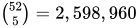
The nCr function on almost scientific calculators tin be used to calculate hand frequencies; inbound nCr with 52 and 5, for example, yields as in a higher place.
| Hand | Distinct hands | Frequency | Probability | Cumulative probability | Odds against | Mathematical expression of absolute frequency |
|---|---|---|---|---|---|---|
| Majestic flush | one | 4 | 0.000154% | 0.000154% | 649,739 : i | |
| Straight flush (excluding royal flush) | ix | 36 | 0.00139% | 0.0015% | 72,192.33 : 1 | |
| 4 of a kind | 156 | 624 | 0.02401% | 0.0256% | 4,164 : 1 | |
| Full house | 156 | 3,744 | 0.1441% | 0.17% | 693.1667 : 1 | |
| Affluent (excluding royal flush and straight flush) | 1,277 | 5,108 | 0.1965% | 0.367% | 508.8019 : 1 | |
| Directly (excluding majestic flush and direct flush) | x | ten,200 | 0.3925% | 0.76% | 253.viii : 1 | |
| Iii of a kind | 858 | 54,912 | 2.1128% | ii.87% | 46.32955 : 1 | |
| Two pair | 858 | 123,552 | 4.7539% | 7.62% | twenty.03535 : i | |
| I pair | 2,860 | 1,098,240 | 42.2569% | 49.9% | 2.366477 : one | |
| No pair / High menu | 1,277 | i,302,540 | fifty.1177% | 100% | 0.9953015 : 1 | |
| Total | 7,462 | 2,598,960 | 100% | --- | 0 : 1 |

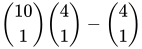
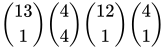
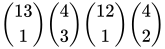
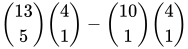
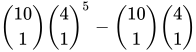
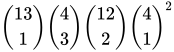
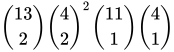
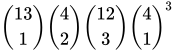
![{\displaystyle \left[{13 \choose 5}-{10 \choose 1}\right]\left[{4 \choose 1}^{5}-{4 \choose 1}\right]}](https://wikimedia.org/api/rest_v1/media/math/render/svg/4e55b66aebde5059a573ac604b5b5ab0a3f72f49)

The royal flush is a case of the straight flush. It can exist formed 4 means (one for each suit), giving information technology a probability of 0.000154% and odds of 649,739 : one.
When ace-depression straights and ace-low directly flushes are not counted, the probabilities of each are reduced: straights and direct flushes each become 9/10 as mutual as they otherwise would exist. The 4 missed direct flushes become flushes and the 1,020 missed straights become no pair.
Annotation that since suits have no relative value in poker, ii hands can be considered identical if ane hand can exist transformed into the other by swapping suits. For example, the manus 3♣ vii♣ 8♣ Q♠ A♠ is identical to three♦ vii♦ viii♦ Q♥ A♥ because replacing all of the clubs in the showtime hand with diamonds and all of the spades with hearts produces the 2d paw. So eliminating identical hands that ignore relative suit values, there are simply 134,459 singled-out easily.
The number of distinct poker hands is even smaller. For instance, 3♣ seven♣ 8♣ Q♠ A♠ and 3♦ vii♣ viii♦ Q♥ A♥ are not identical hands when but ignoring suit assignments considering one hand has three suits, while the other hand has only 2—that divergence could affect the relative value of each hand when there are more cards to come. However, even though the hands are not identical from that perspective, they still grade equivalent poker hands considering each paw is an A-Q-8-7-iii loftier card mitt. At that place are 7,462 distinct poker hands.
Frequency of 7-card poker hands [edit]
In some popular variations of poker such as Texas concord 'em, a actor uses the best five-card poker mitt out of seven cards. The frequencies are calculated in a manner similar to that shown for 5-card hands, except additional complications arise due to the extra ii cards in the 7-menu poker mitt. The full number of distinct 7-card hands is . It is notable that the probability of a no-pair hand is less than the probability of a one-pair or two-pair hand.

The Ace-high straight flush or purple flush is slightly more frequent (4324) than the lower straight flushes (4140 each) considering the remaining 2 cards tin can have any value; a Male monarch-high straight flush, for example, cannot have the Ace of its suit in the manus (as that would make it ace-high instead).
-
Hand Frequency Probability Cumulative Odds against Mathematical expression of absolute frequency Royal affluent 


four,324 0.0032% 0.0032% 30,939 : 1 Straight affluent (excluding royal flush) 


37,260 0.0279% 0.0311% 3,589.six : 1 Four of a kind 


224,848 0.168% 0.199% 594 : 1 Full house 


3,473,184 2.lx% 2.lxxx% 37.5 : 1 Affluent (excluding majestic affluent and straight affluent) 


iv,047,644 iii.03% five.82% 32.1 : 1 Straight (excluding purple affluent and direct flush) 

6,180,020 iv.62% 10.iv% 20.6 : 1 Three of a kind 


6,461,620 4.83% 15.3% 19.7 : i Two pair 


31,433,400 23.5% 38.8% 3.26 : one I pair 
58,627,800 43.viii% 82.6% ane.28 : 1 No pair / Loftier card 


23,294,460 17.4% 100% 4.74 : ane Full 133,784,560 100% --- 0 : 1

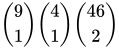

![{\displaystyle {\begin{aligned}&\left[{13 \choose 2}{4 \choose 3}^{2}{44 \choose 1}\right]\\+&\left[{13 \choose 1}{12 \choose 2}{4 \choose 3}{4 \choose 2}^{2}\right]\\+&\left[{13 \choose 1}{12 \choose 1}{11 \choose 2}{4 \choose 3}{4 \choose 2}{4 \choose 1}^{2}\right]\end{aligned}}}](https://wikimedia.org/api/rest_v1/media/math/render/svg/1ed804b46c18539a26943efe404d3baa0eb9e18f)
![{\displaystyle {\begin{aligned}&\left[{4 \choose 1}\times \left[{13 \choose 7}-217\right]\right]\\+&\left[{4 \choose 1}\times \left[{13 \choose 6}-71\right]\times 39\right]\\+&\left[{4 \choose 1}\times \left[{13 \choose 5}-10\right]\times {39 \choose 2}\right]\end{aligned}}}](https://wikimedia.org/api/rest_v1/media/math/render/svg/969ff3345527c27027f25ad37582bf5ecf9bcdf6)
![{\displaystyle {\begin{aligned}&\left[217\times \left[4^{7}-756-4-84\right]\right]\\+&{}\left[71\times 36\times 990\right]\\+&\left[10\times 5\times 4\times \left[256-3\right]+10\times {5 \choose 2}\times 2268\right]\end{aligned}}}](https://wikimedia.org/api/rest_v1/media/math/render/svg/fa134865f6e0974eb9bbb75f64313a6267bf509b)
![{\displaystyle \left[{13 \choose 5}-10\right]{5 \choose 1}{4 \choose 1}\left[{4 \choose 1}^{4}-3\right]}](https://wikimedia.org/api/rest_v1/media/math/render/svg/ed30e7cbf2d5f58a2b1efcd2331edf9355761a2f)
![{\displaystyle {\begin{aligned}&\left[1277\times 10\times \left[6\times 62+24\times 63+6\times 64\right]\right]\\+&\left[{13 \choose 3}{4 \choose 2}^{3}{40 \choose 1}\right]\end{aligned}}}](https://wikimedia.org/api/rest_v1/media/math/render/svg/bf1d1a560d723a8096797bbfa86703aac8b912d6)
![{\displaystyle \left[{13 \choose 6}-71\right]\times 6\times 6\times 990}](https://wikimedia.org/api/rest_v1/media/math/render/svg/b800bb07044dd754c39aea61a1f4085d2d2236e8)
![{\displaystyle 1499\times \left[4^{7}-756-4-84\right]}](https://wikimedia.org/api/rest_v1/media/math/render/svg/d80294394e124f342d3ebf39828f5adec54c708f)

(The frequencies given are exact; the probabilities and odds are approximate.)
Since suits have no relative value in poker, two easily can be considered identical if ane hand can be transformed into the other by swapping suits. Eliminating identical hands that ignore relative suit values leaves half dozen,009,159 singled-out vii-menu hands.
The number of singled-out five-card poker hands that are possible from 7 cards is 4,824. Mayhap surprisingly, this is fewer than the number of five-carte poker hands from 5 cards because some v-menu hands are impossible with vii cards (e.g. 7-loftier).
Frequency of 5-card lowball poker hands [edit]
Some variants of poker, chosen lowball, use a low mitt to determine the winning manus. In about variants of lowball, the ace is counted every bit the lowest card and straights and flushes don't count confronting a low hand, and then the lowest hand is the v-high manus A-2-3-4-five, also called a wheel. The probability is calculated based on , the total number of 5-carte du jour combinations. (The frequencies given are exact; the probabilities and odds are approximate.)
-
Hand Distinct easily Frequency Probability Cumulative Odds against 5-loftier 1 1,024 0.0394% 0.0394% 2,537.05 : ane six-high 5 five,120 0.197% 0.236% 506.61 : 1 7-high fifteen 15,360 0.591% 0.827% 168.twenty : one 8-high 35 35,840 1.38% 2.21% 71.52 : one 9-loftier seventy 71,680 two.76% 4.96% 35.26 : 1 10-high 126 129,024 iv.96% ix.93% 19.14 : 1 Jack-high 210 215,040 8.27% eighteen.two% 11.09 : 1 Queen-high 330 337,920 13.0% 31.2% six.69 : 1 King-high 495 506,880 19.five% fifty.seven% 4.13 : 1 Full ane,287 1,317,888 fifty.7% l.7% 0.97 : ane
As can exist seen from the tabular array, just over half the time a player gets a hand that has no pairs, threes- or fours-of-a-kind. (50.7%)
If aces are not low, simply rotate the hand descriptions so that 6-high replaces 5-high for the best hand and ace-high replaces king-high as the worst mitt.
Some players do non ignore straights and flushes when calculating the low hand in lowball. In this case, the everyman hand is A-ii-iii-4-vi with at least ii suits. Probabilities are adjusted in the above table such that "5-high" is not listed", "six-loftier" has i distinct mitt, and "Rex-high" having 330 distinct hands, respectively. The Total line also needs adjusting.
Frequency of vii-card lowball poker easily [edit]
In some variants of poker a player uses the all-time five-carte depression hand selected from 7 cards. In almost variants of lowball, the ace is counted equally the lowest card and straights and flushes don't count against a low paw, and then the everyman mitt is the five-high hand A-2-3-4-5, too called a bike. The probability is calculated based on , the total number of 7-card combinations.
The table does not extend to include five-card hands with at to the lowest degree one pair. Its "Full" represents the 95.4% of the time that a actor can select a 5-card depression hand without any pair.
-
Mitt Frequency Probability Cumulative Odds against five-high 781,824 0.584% 0.584% 170.12 : one 6-high 3,151,360 2.36% 2.94% 41.45 : i vii-loftier 7,426,560 5.55% eight.49% 17.01 : ane 8-high 13,171,200 9.85% 18.iii% 9.16 : one ix-loftier nineteen,174,400 14.3% 32.7% 5.98 : one 10-high 23,675,904 17.seven% 50.four% 4.65 : ane Jack-high 24,837,120 18.6% 68.9% 4.39 : ane Queen-high 21,457,920 16.0% 85.0% 5.23 : 1 Rex-high 13,939,200 x.4% 95.four% viii.60 : one Total 127,615,488 95.4% 95.iv% 0.05 : one
(The frequencies given are exact; the probabilities and odds are approximate.)
If aces are not low, simply rotate the hand descriptions then that 6-high replaces five-loftier for the best manus and ace-high replaces king-high as the worst paw.
Some players do not ignore straights and flushes when computing the depression hand in lowball. In this case, the everyman hand is A-2-3-4-6 with at to the lowest degree ii suits. Probabilities are adjusted in the to a higher place tabular array such that "5-loftier" is not listed, "6-high" has 781,824 distinct hands, and "King-high" has 21,457,920 distinct easily, respectively. The Total line also needs adjusting.
See as well [edit]
- Probability
- Odds
- Sample space
- Event (probability theory)
- Binomial coefficient
- Combination
- Permutation
- Combinatorial game theory
- Game complexity
- Gear up theory
- Gaming mathematics
Notes [edit]
- ^ "Probability Theory". Science Clarified . Retrieved 7 December 2015.
- ^ "Brief History of Probability". teacher link . Retrieved 7 Dec 2015.
External links [edit]
- Brian Alspach's mathematics and poker page
- MathWorld: Poker
- Poker probabilities including conditional calculations
- Numerous poker probability tables
- v, 6, and 7 card poker probabilities
- Poker Odds for Dummies
- The 7,462 and 4,824 equivalence classes
- Preflop, After Flop and Chance of Making Hand Odds
- Odds and Outs probability table
- Poker probability computer 5, 6 and vii cards
- Visual odds calculator

Do Odds Change Drawing Cards Of Different Number Of Players,
Source: https://en.wikipedia.org/wiki/Poker_probability
Posted by: lundprionat.blogspot.com
0 Response to "Do Odds Change Drawing Cards Of Different Number Of Players"
Post a Comment